Having worked with tens of thousands of Accounts, every now & then get a client call that starts like this:
“Why are our ads not running? We’re paying you.”
And almost every time, the campaigns are running just fine.
What the client saw was something else.
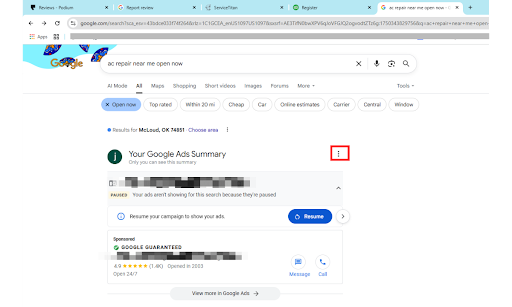
When a client has backend access to their Google Ads account and they Google their own brand name, Google sometimes shows an Ads Summary card right at the top of the search results. Front and center. Prime real estate.
Inside that card, it may display old paused campaigns with a bold message saying, “Your ads aren’t running.” Then a nice, inviting button to “Resume” them immediately.
You can see how this plays out.
The client thinks everything is off.
They think you forgot something.
Or worse, they think they are being billed for nothing.
In reality, those campaigns were intentionally paused. Often, because they were underperforming for your budget or that location. Meanwhile, the actual performing campaigns are active and doing exactly what they should be doing.
But Google does not highlight that.
Here is the part you need to understand as an agency.
Google makes the majority of its revenue from the top portion of the search results page. If its system believes showing that summary card increases the likelihood that someone clicks “Resume” and restarts a campaign, it is going to show it.
That button is not there by accident.
This is why it is critical that you know this functionality exists. And more importantly, that your client knows it exists.
Because without context, it creates confusion.
Confusion creates doubt.
And doubt slowly chips away at trust.
As of now, there is only one practical way to remove that card from appearing:
When the Google Ads Summary card shows up in search results:
• Look for the three vertical dots in the top right corner of the card
• Click those dots
• Select the option to remove or hide the card
That removal is done per appearance from the search results page itself.
It is simple. But if you do not know it is there, it feels alarming.
This is something worth covering during onboarding. A quick two minute explanation can prevent an unnecessary panic call six months down the line. It also positions you as the expert who understands how Google really works behind the scenes.
These small moments matter more than most agencies realize.
Trust is rarely built from big presentations. It is built from preventing small misunderstandings before they turn into bigger issues.
And this is one of those small things that quietly protects the relationship.