For a long time I treated agency growth as a demand problem. More outbound, better scripts, tighter offer, higher close rate. Those inputs matter, and they’re the ones everybody optimizes first because they’re the easiest to measure.
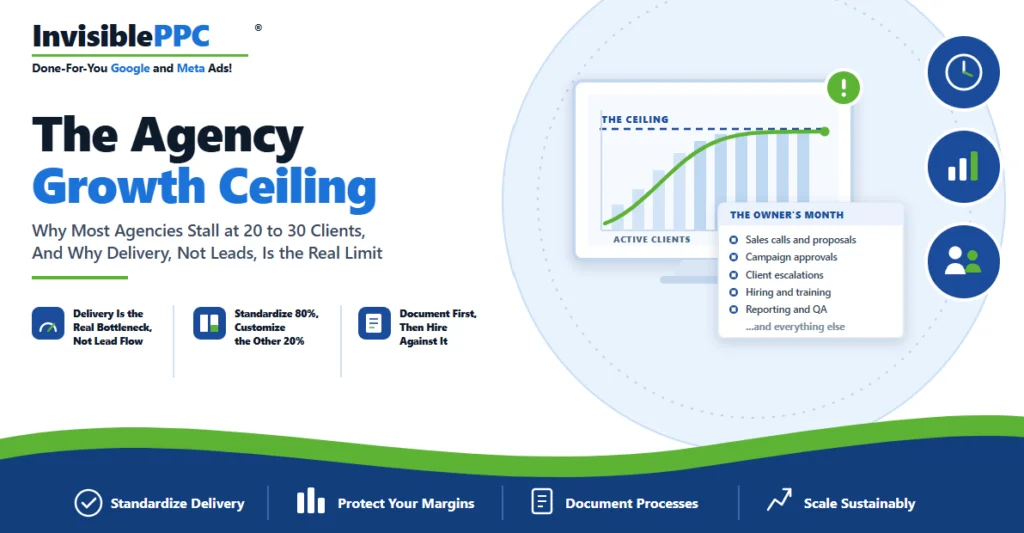
But after working with a few hundred agencies, the pattern I keep running into is different. The agencies that stall aren’t short on prospects. They’ve run out of room to deliver. Somewhere around 20 to 30 active accounts, fulfillment becomes the thing holding everything back, and every new client makes the system worse instead of better.
The specific number isn’t important. Your ceiling depends on retainer size, service complexity, and how much of your delivery is actually documented. The mechanism is what matters, and it looks the same everywhere.
The Ceiling Is Math, Not Mindset
Run the numbers on a fairly ordinary paid media agency. Say the average retainer is $3,500 a month and each account eats up roughly 14 hours of delivery: campaign management, creative refresh, landing page updates, tracking QA, reporting, and the client call. At a blended internal cost of $55 an hour, that’s $770 of delivery cost per account, or about 78 percent gross margin before overhead. Healthy on paper.
Now add the founder. On top of that 14 hours, the owner spends another 2 to 3 hours per account per month on escalations, campaign approvals, strategy calls, and the “let me look at this before it goes live” review that nobody has ever managed to put on a calendar.
| Accounts | Delivery hours/mo | Owner hours/mo | Owner hours available |
|---|---|---|---|
| 10 | 140 | 25 | ~160 |
| 20 | 280 | 50 | ~160 |
| 30 | 420 | 75 | ~160 |
| 40 | 560 | 100 | ~160 |
Delivery hours are solvable. You hire, you contract, you buy capacity. Owner hours aren’t, because that bottom line never moves and the founder is also carrying sales, hiring, finance, and escalations out of the same 160 hours. By 30 accounts, roughly half the founder’s month is going to work that only exists because delivery isn’t standardized enough to run without them.
That’s the ceiling. Not motivation, not marketing. One resource that can’t grow sitting in the middle of every account.
Why It Breaks All At Once
Owners tend to describe the ceiling as everything falling apart at the same time, which is usually accurate. Here’s why it feels that way.
At 12 accounts, your team has slack. Things go wrong constantly in this business: a client changes their offer mid-flight, an ad account gets flagged, a report needs rebuilding because attribution windows shifted. With slack in the schedule, that chaos gets absorbed and nobody outside the team ever notices.
At 28 accounts, the slack is gone. The same amount of chaos now has nowhere to go, so it turns into missed deadlines, weekend work, and a founder personally unblocking things at 9:30 at night. Nothing new broke. You just lost the buffer that was hiding it.
The team side compounds this. Every person you add creates new handoff points, and every handoff without a clear owner is a place work can sit for two days before anyone notices. Four people is manageable. Eight people without documented ownership is a coordination problem disguised as a performance problem.
The Five Bottlenecks
1. The Founder Sits in the Middle of Everything
Every meaningful decision routes through one person: pricing exceptions, creative approvals, escalations, hiring, scope disputes. Work doesn’t stall because your team lacks skill. It stalls waiting on an approval that lives in one inbox.
The fix isn’t stepping back and hoping. It’s giving people real decision rights with a clear line: anything under a defined budget or scope change gets decided by the account lead, anything above it comes to you. Then count how many decisions actually hit your desk per account each month. If it’s more than one, either your thresholds are too tight or your documentation is too thin.
2. Every Account Is a Custom Build
Customization sells beautifully and wrecks your operations. Different reporting cadences, different KPIs, different onboarding, different deliverable formats. Each version is basically a separate product with its own cost to deliver and nothing shared between them.
The alternative is a service catalog. A small number of packaged deliverables with fixed scope, fixed hour budgets, and a fixed cadence, with customization priced separately as a scoped add-on. Standardize about 80 percent and save the variation for the 20 percent that actually moves client results. Good test: could a new hire deliver next month’s work on any given account using just the SOP and the account brief? If not, that account is a custom build and you’re eating the cost of it.
3. Hiring Before You Document Anything
Hiring into an undocumented process turns a delivery problem into a training problem. The new person’s ramp gets paid for out of founder hours, which are already the scarcest thing in the business. That’s why capacity often drops for 60 to 90 days after a hire instead of going up.
Track SOP coverage as an actual number: what percentage of your recurring delivery tasks have a written, current, usable procedure attached. Under 50 percent, hiring reliably makes the founder busier. Above 80 percent, onboarding stops being apprenticeship and starts being execution, and ramp time drops fast. Document first, then hire against it.
4. Serving Everyone Means Rebuilding Everything
Generalist positioning has a very specific cost: you rebuild your research from scratch on every account. New vertical means new competitor analysis, new messaging, new landing page structure, new benchmarks for what a good cost per lead even looks like in that industry.
Vertical focus turns that same work into an asset you reuse. Creative libraries, page templates, keyword sets, tested offer structures, seasonality patterns, and real benchmark data from a book of similar accounts. Onboarding gets shorter, time to first result gets shorter, and your diagnosis gets sharper because you’ve seen the same failure modes across 30 similar businesses instead of 30 different industries. That shows up directly in delivery hours per account.
5. Fulfillment Cost Grows With Every Client, Price Doesn't
This is the one that quietly kills margin. Delivery cost per account barely moves, so your total delivery cost climbs steadily with every client you sign. Management overhead climbs faster once you’re adding account managers, QA, and coordination on top. Revenue climbs too, but only in a straight line, and slower than that if you’re discounting to win volume.
Watch two numbers monthly: revenue per delivery FTE and gross margin per account. If revenue per FTE is flat or falling as you add clients, you’re buying growth with margin. Plenty of agencies do this for a year without noticing, because top line revenue keeps going up while the profit on each account quietly erodes underneath it.
Measure It Before You Scale It
Most agencies at the ceiling can tell you monthly revenue and roughly what they pay people. That’s not enough to fix a capacity problem. The numbers that surface the ceiling before revenue does:
- Delivery hours per account, by service line. What each client actually costs you. Without it, pricing is guesswork.
- Gross margin per account. Ranked worst to best. The bottom quartile is usually where all your time is going.
- Revenue per delivery FTE. Your leverage number. It should hold or rise as you grow, never fall.
- Owner touchpoints per account per month. How much of the business still needs you personally.
- SOP coverage. Percentage of recurring tasks with current documentation.
- Escalation rate. How many issues per account per month leave the normal workflow. A rising escalation rate is your earliest warning that the process no longer fits the volume.
Track these for a quarter and the bottleneck stops being a feeling. It becomes a specific list of accounts and a specific gap in your process.
More Capacity Doesn't Always Mean More Employees
The default assumption is that more clients require more staff. Sometimes true, often not, and the difference is really a decision about your cost structure.
Full time hires turn delivery into a fixed cost. That works well when utilization is high and steady, and it hurts badly when a big account churns and you’re carrying salaries against revenue that no longer exists. Specialist partners and white label fulfillment turn delivery into a variable cost instead. Margin per account is lower, but capacity flexes with your book and no single churn event blows a hole in your P&L.
The setup I see working most often keeps strategy, client relationships, and sales in-house, since those are what drive retention and pricing power, and pushes execution heavy work to partners or a documented internal pod. The founder’s time shifts from reviewing campaigns to acquisition, positioning, and the handful of relationships that genuinely need them.
Client experience holds up because quality was never really about who touched the account. It was about whether the process was defined.
What Actually Changes at the Ceiling
There’s no universal number. Some agencies hit the wall at 15 accounts because the work is complex and the founder is the entire strategy function. Others run past 40 on standardized offers with tight documentation.
What’s consistent is the transition. Below the ceiling, effort produces output. Above it, effort mostly produces coordination, and the founder working more hours makes the whole thing slower instead of faster.
The agencies that break through aren’t better marketers. They’re better operators. They know what delivery actually costs them, they’ve standardized whatever repeats, they’ve moved decisions out of the founder’s inbox, and they’ve built a cost structure that can take on the next ten accounts without asking anyone to give up their weekend.
Growth stops being a demand problem the moment you can answer this cleanly: if ten clients signed on Monday, what exactly breaks, and what would it cost to fix before they onboard? Most owners can’t answer that. The ones who can are the ones still growing at 50.