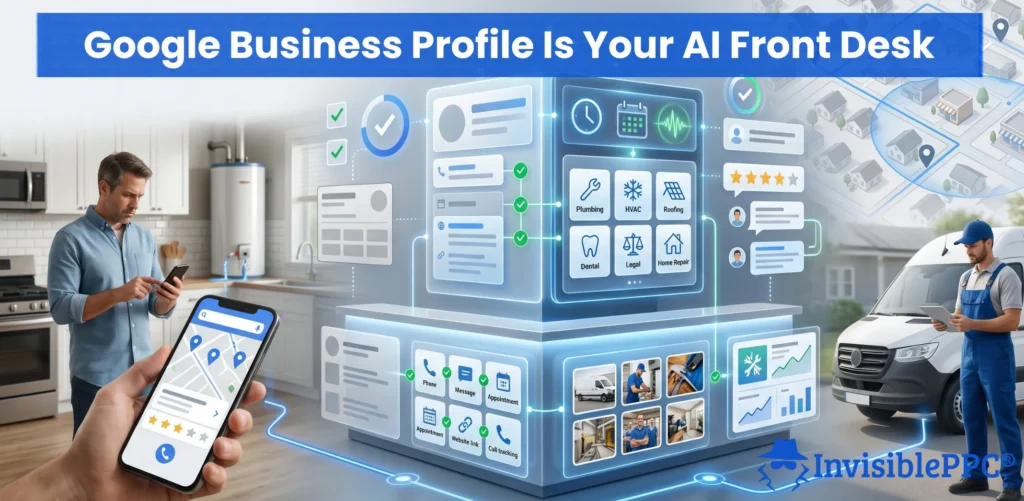
Most local service businesses still think of their Google Business Profile as a basic listing.
Name. Address. Phone number. Hours. Maybe a few photos. Maybe a post from six months ago that no one remembers publishing.
But that’s not how customers use it anymore.
For many local searches, the Google Business Profile is the first impression, the trust filter, the conversion point, and sometimes the only thing a customer looks at before they call.
And now, with Google bringing Gemini into Business Profile management and making “Ask Maps”more conversational with AI-assisted local discovery, agencies need to pay attention.
Google Business Profile Is Becoming More Than a Listing
Google now allows business owners to connect Google Business Profile with Gemini. That lets Gemini help with tasks like updating business hours, changing contact information, creating Business Profile posts, drafting review replies, summarizing customer feedback, and reviewing performance insights.
At first glance, that sounds like a productivity feature.
And sure, part of it is.
But the bigger signal is that Google wants Business Profiles to become easier to manage because they are becoming more central to how people discover and evaluate local businesses.
This matters a lot for local service clients.
A homeowner with a leaking water heater may never spend ten minutes comparing websites. They may open Google, scan the local results, read a few reviews, check who looks available, and call directly from the profile.
An HVAC customer may search for emergency AC repair, compare ratings, look at service areas, check photos, and tap the call button without ever clicking to the website.
A legal, dental, roofing, plumbing, or home services lead may form an opinion before they ever see your landing page.
That means the Business Profile is not just supporting the marketing funnel.
In many cases, it is the marketing funnel.
AI Is Changing How Local Discovery Works
For years, local SEO conversations have been built around rankings.
Who is in the map pack?
Who is number one?
Who has the most reviews?
Those things still matter. But they are not the whole story anymore.
Google Maps is becoming more conversational. With Ask Maps, users can ask more detailed questions and get AI-assisted recommendations based on what they are trying to do.
That changes the nature of the search.
Instead of only typing:
“plumber near me”
A customer might ask:
“Who can fix a leaking water heater today and has good reviews for emergency service?”
Instead of:
“HVAC company Austin”
They might ask:
“Find an HVAC company near me that works on older systems and is open now.”
That is a very different local search environment.
The question is no longer just, “Can your client rank?”
The question becomes, “Does Google have enough clear, accurate, trusted information to recommend your client for the right job?”
That is where many local businesses are weak.
They may have a verified profile. They may have reviews. They may even show up sometimes.
But their services are incomplete. Their hours are vague. Their photos are outdated. Their review responses are generic. Their contact paths are not properly checked. Their posts are inconsistent. Their categories are too broad.
Those weaknesses may not look dramatic in a monthly report.
But they can quietly cost leads.
The Client Will Not Explain the Problem This Way
Here is the tricky part for agencies.
Clients will not call and say:
“I am concerned that my Business Profile lacks enough service-specific trust signals for AI-assisted local discovery.”
They will say:
“Leads feel slow.”
“My competitor is showing up more.”
“We are getting fewer calls.”
“Someone said they messaged us, but we never saw it.”
“Why are we not getting the emergency jobs?”
And by the time they say those things, the relationship may already be tense.
That is why agencies should bring this up before the client feels the pain.
This is an opportunity to look proactive.
A strong agency can say:
“Google is adding more AI into Business Profiles, Maps, and local discovery. We are auditing your profile to make sure your services, contact information, reviews, photos, hours, and conversion paths are accurate.”
That is a valuable client conversation.
It shows the agency is not just checking campaign metrics. It shows they understand how local customers actually choose businesses.
What Agencies Should Audit First
This does not need to become a huge project.
Start with the areas most likely to affect lead volume and trust.
1. Contact Paths
Every contact option on the Business Profile should be tested.
That includes:
- Phone number
- Website link
- Appointment link
- Messaging options
- Text message setup
- WhatsApp setup if enabled
- Call tracking numbers
- Location-specific numbers for multi-location businesses
This is not glamorous work.
But it is important.
If the wrong phone number is listed, the client loses leads. If the appointment link is broken, the client loses leads. If messaging is enabled but no one monitors it, the client loses leads.
And when the client loses leads, they usually blame marketing before they blame a contact setting.
2. Business Hours and Emergency Availability
For local service businesses, hours are not a small detail.
They shape whether someone calls.
If a plumber offers emergency service, that needs to be clear. If an HVAC company answers after-hours calls, that needs to be reflected properly. If the business is technically closed but dispatch is still available, the profile should not confuse customers.
The opposite is also true.
If the profile says the business is open but no one answers, that damages trust.
Agencies should verify regular hours, holiday hours, emergency availability, and after-hours contact expectations.
3. Services and Categories
A lot of Business Profiles are too generic.
“Plumber” is not enough.
“HVAC contractor” is not enough.
“Law firm” is not enough.
Google needs clearer signals. So do customers.
For a plumbing client, the profile should support specific services like drain cleaning, water heater repair, leak detection, sewer line repair, hydro jetting, emergency plumbing, and fixture installation.
For an HVAC client, it may need AC repair, furnace repair, heat pump service, ductless systems, maintenance plans, indoor air quality, and emergency service.
This is where agencies can help clients connect local SEO to actual revenue.
The goal is not to list every possible service just to look complete.
The goal is to make sure the profile supports the services the client actually wants to sell.
4. Reviews and Review Responses
Reviews are no longer just social proof.
They are local business data.
They tell customers what the business is good at. They tell Google what people associate with the business. They reveal service quality, speed, professionalism, pricing concerns, location patterns, and specific job types.
Agencies should look at:
- Review velocity
- Service keywords inside reviews
- Location mentions
- Common customer complaints
- Competitor review gaps
- Whether the business replies like a real human
Generic review replies do not help much.
“Thank you for your feedback” is better than silence, but not by much.
A stronger reply reinforces the service and customer experience.
For example:
“Thanks, Sarah. We are glad our team could get your AC running again before the weekend. We appreciate you trusting us with your home in Round Rock.”
That response feels human. It also reinforces service and location relevance in a natural way.
5. Photos and Visual Trust
Local service businesses do not need magazine-quality photography.
They need proof.
Real trucks. Real technicians. Real job sites. Real equipment. Real team members. Real before and after photos when appropriate.
A Business Profile with old, low-quality, or irrelevant photos can make a strong company look inactive.
And customers do judge that.
If the competitor has fresh truck photos, team photos, completed job photos, and active review responses, while your client has three blurry images from 2019, that difference matters.
6. Business Profile Posts
Posts are not a magic ranking lever.
But they are useful.
They show activity. They highlight offers. They reinforce seasonal services. They give customers another reason to act.
For local service businesses, agencies can use posts for:
- Seasonal tune-ups
- Emergency service reminders
- Financing offers
- Maintenance plans
- New service areas
- Storm-related updates
- Heat wave or cold weather service messaging
The key is to keep posts practical.
Nobody needs a generic “Happy Monday” post from a plumbing company.
But a post about water heater warning signs, AC tune-ups before peak summer, or emergency roof inspections after a storm can support real customer demand.
The Bigger Point for Agencies
This is not about chasing every new AI feature.
That is not the right message.
The real message is simpler:
Google is getting better at using business information to answer more specific local questions. So your client’s information needs to be accurate, complete, active, and tied to the services they actually want to sell.
That is not hype.
That is good local marketing.
For agencies, this creates a clear retention opportunity.
You can go to your clients and say:
“Google is changing how people discover local businesses. We are reviewing your Business Profile to make sure your contact options, services, reviews, hours, photos, and posts are aligned with how customers are searching now.”
That is the kind of proactive account management clients remember.
It also makes Local SEO easier to explain.
You are not “optimizing a profile.”
You are making sure Google and potential customers have the right information to choose that business.
That is a stronger value proposition.
What Agencies Should Do This Month
Here is a simple action plan:
- Audit every active local service client’s Google Business Profile.
- Test every contact path, including call, website, appointment, text, and WhatsApp if enabled.
- Confirm hours, emergency availability, and holiday schedules.
- Review primary and secondary categories.
- Update services based on the client’s highest-value jobs.
- Review photos and request fresh assets from the client.
- Analyze reviews for recurring service and location themes.
- Improve review response quality.
- Create a simple monthly GBP posting rhythm.
- Explain the work to clients in plain English.
That last point matters.
Do not just do the work silently.
Tell the client why you are doing it.
Clients do not always value what they cannot see. A simple note, audit summary, or reporting meeting update can turn behind-the-scenes work into perceived expertise.
Final Thought
Google Business Profile is becoming one of the most important local conversion assets your client has.
Not because it is new.
Because customer behavior is changing around it.
People want faster answers. Google is using AI to provide more direct recommendations. Local customers are making decisions before they ever land on the website.
That means agencies have to treat the Business Profile as an active lead generation asset, not a one-time setup task.
The agencies that understand this will have better conversations with clients.
They will catch problems earlier.
They will create more value from Local SEO.
And they will be better positioned as Google keeps adding AI into local discovery.
Need Help Delivering Local Marketing for Your Clients?
If your agency works with local service businesses, your clients need more than a basic Business Profile setup.
They need ongoing Local SEO, Google Business Profile management, review strategy, PPC, landing pages, and reporting that connects the work to lead generation.
InvisiblePPC helps agencies deliver these services under their own brand, without having to build the entire fulfillment team in-house.